A Coin Is Flipped and Lands on Heads What Is the Probability It Lands on Heads Again
Jungsun Choi and Junho Oh from Nanjing International School sent some wonderful thoughts to each function of this problem. In this solution I give each of their comments for comparison, forth with some of my ain thoughts and comments.
A fundamental fact in this problem is that it takes, on boilerplate, 2046 flips to attain 10 heads in a row. Assay of this problem is fascinating considering it draws together a fascinating mix of theoretical and numerical probability along with estimates and approximations.
1. Jungsun: There is an 1/two chance to get a head of a coin each time. To get ten heads in a row, an 1/2 adventure has to be multiplied for x times. So, the formula to complete the coin scam on the beginning endeavor is $(one/two)^{10}$. As a result, the chance of DB completing the coin scam on the beginning attempt is 1/1024.
Junho: The chance of DB completing the coin scam on the first effort, which is to toss a coin and get 10 heads in a row, is very unlikely. When calculated, the probability of this happening is 1/1024 which is almost 0.000967.
2. Jungsun: The chance to consummate the coin scam on the first attempt is 1/1024, and it means that statistically, among 1024 trials (of 10 flips in a row), 1 trial may succeed to become 10 heads in a row.
Junho: According to probability, there is a 1/1024 chance of getting ten consecutive heads (in a run of 10 flips in a row). However, this does not mean that it volition be exactly that number. It might take ane person less throws to get 10 consecutive heads. As well, 1 might spend the whole solar day trying to go it, but not succeed.
Steve: The actual exact expectation adding is complicated because DB did not do sequences of 10 coin flips: he carried on until 10 in a row were seen; this is not the aforementioned as doing several private trials of ten flips. The total computation involves conditional probability, and works out to be
$$
\begin{eqnarray}
Due east(10H)&=&East(10H|10H)P(10H)+E(10H|9HT)P(9HT)\cr
&+&E(10H|8HT)P(8HT)+\dots +E(10H|0HT)P(0HT)\cr
&=&two^{11}-two = 2046
\end{eqnarray}
$$
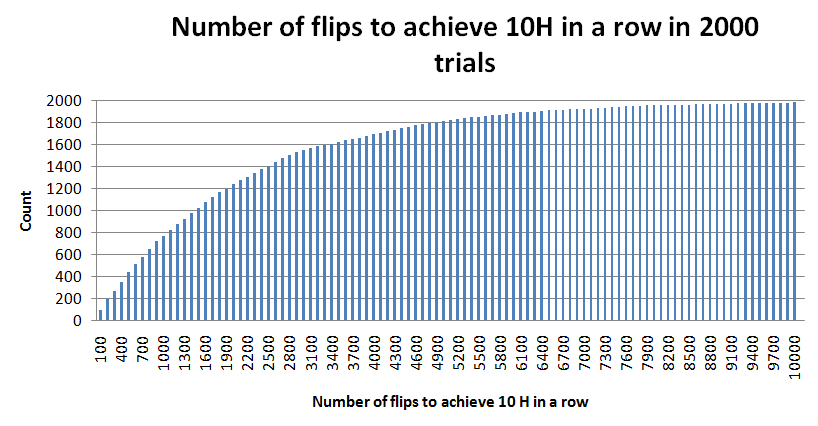
The problem points to the fact that both the average and spread are relevant in probability calculations. I ran a simulation to determine the time of completion of trials in 2000 cases. You can view the information in this spreadsheet. The average for my trials was a trivial over 2053 (a little more than because I terminated the trials at 10000 runs). The cumulative frequency chart was as follows:
3. Jungsun: Considering his 5000 trials were all failed, he has to practise the experiments again.
Junho: In order to make ten consecutive heads, it is merely a matter of adventure. In that location is no exact number of flips that 1 can throw to go 10 sequent coins; that is simply a number of probability. There is no guarantee that ten more flips will brand 10 consecutive heads. Theoretically, one is supposed to go it after flipping 2046 times. But since this person did information technology already 5000 times and didn't get x sequent heads, practice it at to the lowest degree 2046 times once more. (on boilerplate)
Steve: Coin flips are memoryless: regardless of how many previous flips have failed, I volition still expect to have to make, on average, 2046 more flips. This is one of the most disruptive aspects about probability to many people. Being able to recall conspicuously 'What is the situation NOW? Do any PAST (i.eastward. happened) events result any FUTURE (i.e. still to happen) events?' really helps with probability.
4. Junho: If it takes 2046 flips to get 10 sequent heads, theoretically, and a flip takes one second, that will take: 2046 seconds / lx = about 34.1 minutes. But there are times when people get bored or go tired of flipping coins and since probability is never exact, information technology volition probably accept much longer than this. This is just the (average) amount of time it will have to get 10 consecutive heads.
Steve: Junho's points are very articulate. To be reasonably confident of success we should probably permit more than the boilerplate of 2046 flips. As with whatever statistical ciphering we demand to requite a articulate quantitative definition to whatever 'loose' terms. We could, for example, determine 'reasonable confidence' as equating to an '80% gamble of success within a run of N flips'. Once this is done, we can compute. Given such large numbers, numerical simulations will serve us well when the exact computation is too difficult. Reading values off the cumulative frequency nautical chart above shows that you would exist 'reasonably confident' to succeed in less than 5000 flips.
5. Junho: This person can flip a coin in a 2d. At that place is only 10 minutes left which ways this person can throw: $10\times 60 = 600$ throws. The possibility of getting 10 sequent heads is 2046. If this person is lucky, he or she will get 10 consecutive heads, but is highly unlikely. The chances of achieving this is (almost) $600/2046=0.293$.
Steve: In probability theory it is useful to distinguish between estimates for a probability and the exact probability. And then, in this question nosotros might reasonably approximate the risk of sucess as 600/2046 but would need to perform a computation or numerical simulation to make up one's mind the probability more precisely. This randomised spreadsheet shows that the chance is about 25%; alternatively nosotros can read the value off the cumulative frequency nautical chart above.
vi. Jungsun:It is really helpful. Permit's see the divergence betwixt $(50/100)^{10}=0.000977$ and $(55/100)^{ten}=0.002533$: the probability of improved 1 is 3 times more than the previous 1. As a result, it is really helpful to change the chance of heads on each throw.
Junho: Already, the head has a 5% more chance than getting the tail. This will save a lot of time and it will probably accept less flips to become ten sequent flips, theoretically
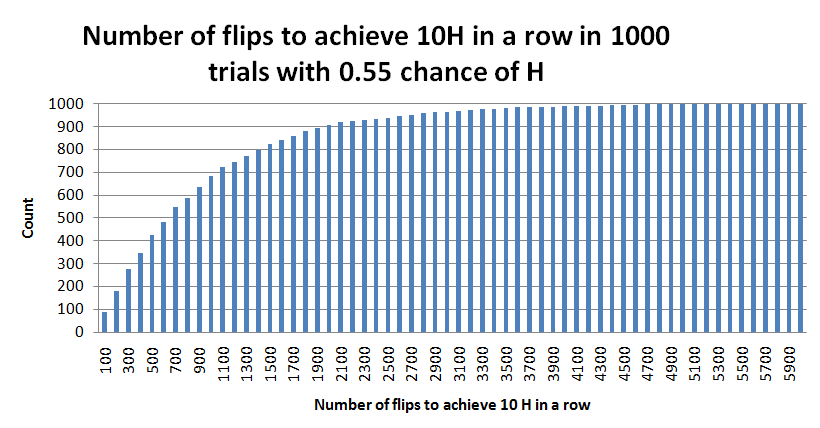
Steve: These relatively pocket-sized changes build up. With this biased money, I found the following relative frequency nautical chart and an average run time of 881 flips.
7. Jungsun: How high a coin goes up is one of the most of import physical factor. If it is thrown likewise low, it is much easier to predict whether head or tail is going to be upwards. Besides, the number of turns is also important. If a money is thrown straight up, it can be controlled which side is going to be upward.
Junho: Physical furnishings might bias the results or affect the outcome; whatsoever air current affecting the coin, the surface where the coin lands might be tilted
Steve: An sometime boss of mine used to exist able to 'flip' a money without it actually spinning; so beware! Slightly weighting ane side of a money tin slightly change its chance of landing upwardly one face or the other. The previous part of this question shows that this might transpire to be meaning.
8. Jungsun: He is quite unlucky, I believe. According to the fourth dimension I expected, it simply takes less than 3 hours. He, however, took ten hours to complete and it is more than than three times to the fourth dimension that I predicted. I believed it just requires less than i/8 of a day, but he spent more than 2/v of a day which is quite unfortunate.
Junho: It took him 10 hours to go 10 heads consecutively. Theoretically, one is supposed to go it in 2046 flips. Nosotros do not know how fast he flipped the coins, but if we say that it took 1 flip took 1 second, he flipped: $ten\times 60\times 60 = 36000$ times. He probably did fewer throws because he couldn't take thrown a coin in 1 second each time. We cannot decide whether he is unlucky or non because nosotros do not have enough data to judge if he is unlucky or not. Also, what differentiates quite unlucky from very unlucky? We are non quite certain. If these vague points tin be clarified, then nosotros can come to a determination on how unlucky or lucky he was
Steve: As in before questions, we need to requite precise quantitative definitions earlier we tin can perform a detailed assay. Perhaps we might ascertain 'very unlucky' as 'Imagine many people undertook the coin flipping experiment and recorded the time taken. Very unlucky people were in the longest 5% of times taken'. From the cumulative frequency chart, we ascertain very unlucky people to take more than 6500 money flips. If nosotros can assume about 1 flip per 5 seconds then this equates to 7200 flips, which does indeed render Derrin Brown very unluckly with the amount of time taken.
9. Jungsun: The population of the Great britain is about 61,400,000. The chance of shortest number of flips is 1/1024. Then multiplying $61,400,000 \times (ane/1024)$ give $59960.9$. As a result, almost $59961$ people are estimated to complete the coin scam in the shortest number of flips.
Junho: The shortest number of flips is of course 10. The chances of this situation happening is very, very low. Just probability is but probability, it is but like the lottery. United kingdom of great britain and northern ireland has a big population, and if every single person tried this, it is to no surprise that someone might finish in just 10 flips. Others, might accept days, weeks, and months to go 10 consecutive These people might not get ten sequent heads forever. Every bit stated before, probability is just probability. It might never happen.
Steve: We are interested in estimating the length of the longest flip sequence. We tin can utilize our cumulative frequency chart to a higher place to assistance us estimate this: after nearly 1600 flips about one-half of the people flipping will have completed the process. Since the process is memoryless, nearly half of the remaining people volition accept completed the process after another 1600 flips. We need to halve 61 million near 25 times to get down to the last person. Thus, we gauge that the longest flip runs will exist virtually $25\times 1600 = 40000$.
10. Jungsun: If there is no limit of time, unlimited number of heads in a row is possible. However, it would require heaps of, heaps of fourth dimension :-)
Junho: This stunt would be much more practical if the person stopped when there are 5 sequent heads. This would non greatly reduce the failure rate merely also increase the probability of really achieving the wanted result.
A Coin Is Flipped and Lands on Heads What Is the Probability It Lands on Heads Again
Source: https://nrich.maths.org/6954/solution
0 Response to "A Coin Is Flipped and Lands on Heads What Is the Probability It Lands on Heads Again"
Post a Comment